WhyArePhoenixConstructionFirmsBecomingPrimeRansomwareTargets?
Why
Are
Phoenix
Construction
Firms
Becoming
Prime
Ransomware
Targets?



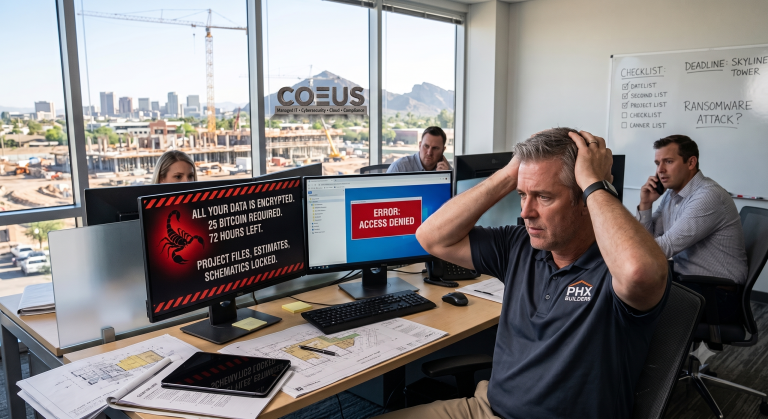
Phoenix construction firms are increasingly targeted by ransomware because the Arizona Surge has made them fast-growing and high-value, while dozens of subcontractor relationships and mobile field teams leave security gaps that haven’t kept pace with growth.
Construction ransomware victims rose 44% year-over-year in Q1 2026, according to GuidePoint Security’s latest threat report, pushing construction into the top five most-targeted industries alongside manufacturing, healthcare, and legal services. Twenty-two distinct threat groups claimed construction victims in that quarter alone. Arizona’s building boom—data centers, semiconductor plants, and the web of trades supporting them—puts local firms squarely in that path, and the trend line shows no sign of reversing.
The same forces driving Arizona’s construction boom are the ones widening its attack surface. Firms scaling from a handful of employees to hundreds in a matter of months are onboarding new hires, new subcontractors, and new field devices faster than their IT and security practices can keep up. Attackers know this: rapid, well-funded growth without a matching security investment is exactly the profile ransomware groups look for.
Ransomware operators look for three things: valuable data, urgency to pay, and gaps in defense. Construction checks every box.
Most construction ransomware incidents don’t start with a dramatic hack—they start with something that looks completely ordinary. In Business Email Compromise, attackers impersonate a general contractor, subcontractor, or vendor to redirect a pay application or change a wire instruction; with money moving between dozens of parties on any given project, a single altered invoice can go unnoticed until the funds are already gone. A general contractor’s own defenses might be solid, but its network is only as strong as the least-protected subcontractor sharing files on it, and attackers increasingly target smaller subs as a way in. Weak passwords, credentials reused across multiple project platforms, and unmanaged personal devices in the field remain some of the easiest entry points available.
Construction firms don’t need enterprise-level security budgets to close these gaps—they need the right priorities, applied consistently: 24/7 threat monitoring through a dedicated Security Operations Center that catches threats before they spread; AI-powered email security that catches spoofed domains and suspicious payment-change requests; continuous, automated backups so project data can be restored without paying a ransom; vendor and access management that segments file access by role and by project; and a flexible IT model that matches the job, tied to active headcount so protection scales up and down with each project’s lifecycle.
Local team. Real answers. We pick up the phone. Tell us what your business runs on and we will show you what a documented, monitored and compliant environment looks like.
Expires in


Limited time offer
We rebuilt your site for you. Claim it and we handle everything transfer, hosting, and your domain. Then update it anytime, just by asking AI.
 Claim limited offer now